The practical answer
Divide the landed cost (goods after discounts, plus shipping, other charges and any VAT added at checkout, converted to one currency) by the milligrams you can actually use. Start with labelled milligrams; when a certificate states net peptide content on a gross-mass basis, multiply the labelled mass by that percentage first. Net peptide content excludes counter-ions such as TFA or acetate, and moisture, so a cheaper sticker price can cost more per usable milligram. [1] [2]
Evidence, method & source dates ↓Start with this documentation source
Research supplier
OMNI Peptides
Request a lot-matched original certificate of analysis with method, laboratory and test date, plus a complete delivery quotation for your destination. Leave the review unresolved if those records cannot be supplied.
Not publicly listed; check the gated catalog
Site sits behind a research-access gate. Vendor statements are not independent test results. No purchase or supplier-quality assessment performed.
Affiliate link: we may earn a commission on an eligible purchase. Link disclosure
Start with this documentation source
Research supplier
Peptides EU
Compare posted HPLC and mass-spectrometry documentation claims against a lot-matched original report and a complete delivery quotation; exclude if only a marketing purity badge is available or if quantity basis is undefined.
Product prices not evaluated
Vendor statements are not independent test results. No purchase or supplier-quality assessment performed.
Affiliate link: we may earn a commission on an eligible purchase. Link disclosure
The formula in three steps
Step 1, landed cost: number of vials times price per vial, minus any volume discount, plus shipping and other charges, plus VAT if it is added at checkout, all converted to one currency at a dated exchange rate.
Step 2, cost per labelled milligram: landed cost divided by vials times labelled milligrams per vial. This is the fairest number you can calculate from a product page alone.
Step 3, cost per usable milligram: landed cost divided by labelled milligrams times net peptide content. Use it only when a certificate states net peptide content and its mass basis. If content is not stated, leave this column blank. Entering 100 percent would silently favour the listing that tells you least.
| Input | Where to find it | If it is missing |
|---|---|---|
| Price per vial and size | Product page, dated | Do not compare from memory; recheck |
| Volume or reorder discount | Product page or checkout | Use zero and note it |
| Shipping to your address | Checkout or written quote | Use the published minimum and mark it a floor |
| VAT treatment | Terms or checkout | Run the comparison both with and without |
| Exchange rate | A dated official reference rate | Do not mix currencies |
| Salt form | Product page or certificate | Mark unknown and ask |
| Net peptide content and basis | Lot certificate | Leave usable mg blank |
Why a labelled milligram is not a usable milligram
Bachem's quality-control guide defines net peptide content as the percentage of peptide relative to non-peptide material, which is mostly counter-ions and moisture. It notes that most peptides contain trifluoroacetic acid or acetic acid, that water is measured separately by Karl Fischer titration, and that a low net peptide content must be expected for peptides with many basic amino acids. [1]
HPLC purity measures something else. GenScript describes it as the area percent of the target peptide's peak in the chromatogram. [2] A vial can be 99 percent pure by HPLC and still contain substantially less than its labelled mass of peptide, because purity is calculated among the peaks the detector sees, while counter-ions and water also add weight.
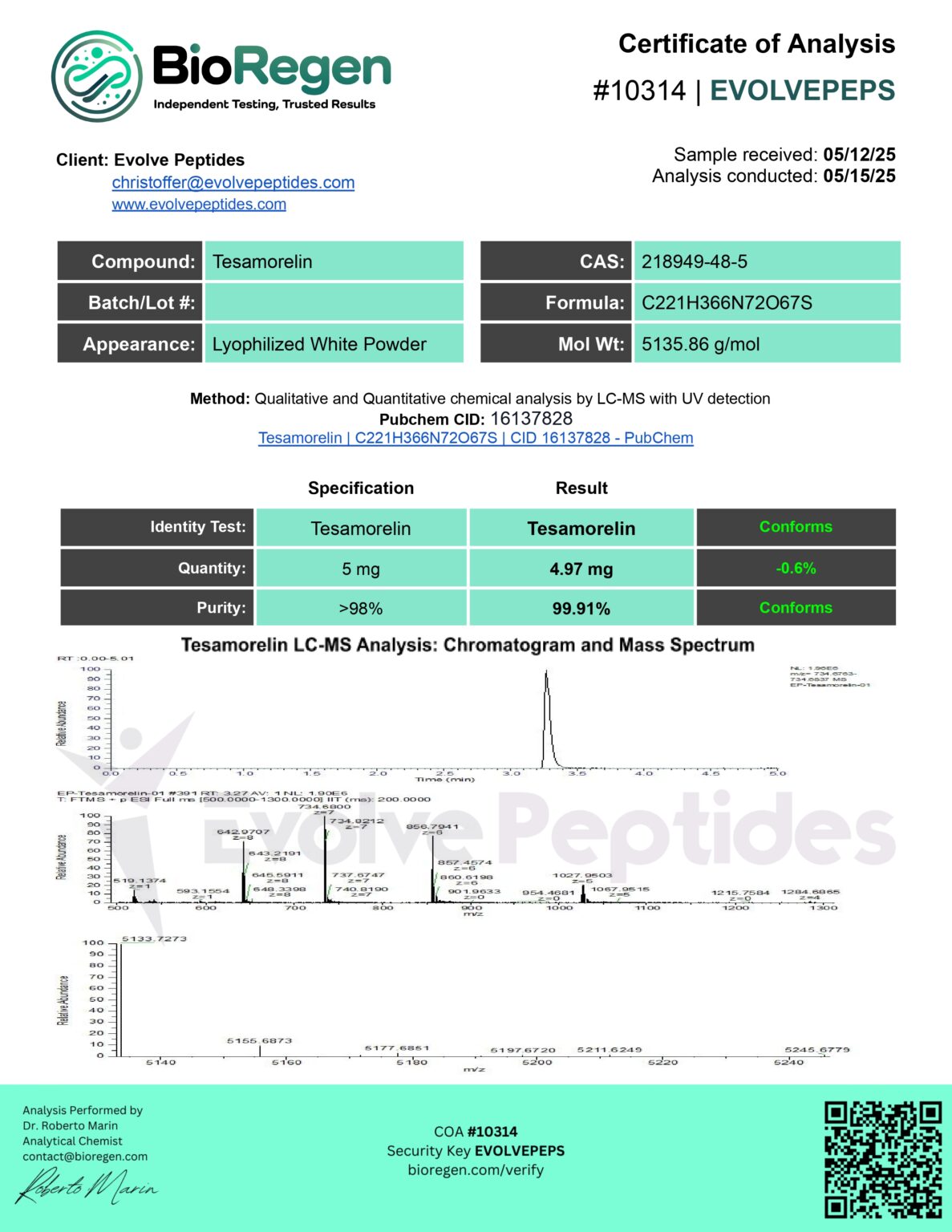
The listings we checked rarely give you what you need. The Peptides EU tesamorelin page states purity of at least 99 percent but no salt form or net peptide content. [3] An Evolve Peptides purity report for tesamorelin 5 mg gives a quantity result of 4.97 mg against a 5 mg specification without saying whether that is gross mass or peptide content. [4] [5] Ask the supplier to state the basis before you treat any quantity as usable milligrams.
Some buyers multiply net peptide content by HPLC purity to estimate target peptide mass. Do that only if the certificate defines both figures and your reviewer accepts area percent as a proxy for mass; the two numbers measure different things. [1] [2]
Three worked comparisons where the cheaper sticker costs more
These listings are fictional so that every input is known. The worksheet reproduces them.
| Comparison | Listing | Landed cost | Usable or labelled mg | Cost per mg | Result |
|---|---|---|---|---|---|
| 1. Net content | A: EUR 50 for 10 mg, content 65%, EUR 8 shipping | EUR 58.00 | 6.5 usable | EUR 8.92 | A is EUR 8 cheaper on the sticker but 15% dearer per usable mg |
| 1. Net content | B: EUR 58 for 10 mg, content 85%, EUR 8 shipping | EUR 66.00 | 8.5 usable | EUR 7.76 | |
| 2. Vial size and shipping | C: EUR 30 per 5 mg vial, two vials, EUR 15 shipping | EUR 75.00 | 10 labelled | EUR 7.50 | C has the lower vial price but costs 10% more per mg |
| 2. Vial size and shipping | D: EUR 68 per 10 mg vial, free shipping | EUR 68.00 | 10 labelled | EUR 6.80 | |
| 3. Labelled basis and salt | E: EUR 80 for 10 mg stated as net peptide, EUR 8 shipping | EUR 88.00 | 10 usable | EUR 8.80 | |
| 3. Labelled basis and salt | F: EUR 70 for 10 mg gross, TFA salt, content 78%, EUR 8 shipping | EUR 78.00 | 7.8 usable | EUR 10.00 | F looks EUR 10 cheaper but costs 14% more per usable mg |
Real price ladders, dated 29 October 2026
From listed prices only, per labelled milligram, before shipping and tax. They show why you should calculate every size, not just the headline one. [3] [6] [9]
| Supplier and listing | Price | Per labelled mg | What it shows |
|---|---|---|---|
| Peptides EU, tesamorelin 2 mg | EUR 36.00 | EUR 18.00 | Small vials carry a large premium |
| Peptides EU, tesamorelin 20 mg | EUR 198.75 | EUR 9.94 | |
| Peptides EU, tirzepatide 70 mg | EUR 119.99 | EUR 1.71 | A bigger vial is not always cheaper per mg |
| Peptides EU, tirzepatide 80 mg | EUR 139.45 | EUR 1.74 | |
| Evolve Peptides, BPC-157 5 mg | USD 39.90 | USD 7.98 | Doubling the size cut the per-mg price by 31% |
| Evolve Peptides, BPC-157 10 mg | USD 54.90 | USD 5.49 | |
| OMNI Peptides | Not public | Not calculable | Catalog is behind an eligibility gate |
Comparing across currencies and borders
On 29 October 2026 Evolve Peptides listed "Tesa 5 mg" at USD 65.00, and Peptides EU listed tesamorelin 5 mg at EUR 66.00. [3] [6] At the European Central Bank's reference rate for that day, 1 euro = 1.1130 US dollars, USD 65.00 is EUR 58.40, or EUR 11.68 per labelled mg against EUR 13.20. [7]
Add published shipping and the gap narrows. Evolve's standard US shipping is USD 14.90 below a USD 200 order, making USD 79.90, or EUR 71.79 and EUR 14.36 per mg. Peptides EU's minimum shipping makes EUR 73.99, or EUR 14.80 per mg. [8] [10]
The comparison is mostly academic. Evolve's shipping policy says it ships to the United States and Canada, and Peptides EU describes delivery to EU countries, so few buyers can choose between them. [8] [10] There is a second warning in the documents: the Evolve certificate lists tesamorelin under CAS 218949-48-5, Evolve's own product page lists CAS 901758-09-6, and the Peptides EU page lists CAS 901758-57-6. [3] [4] [5] Different registry numbers can mean different forms of the material, such as a salt versus the free peptide. Ask both suppliers what exactly they ship before treating the two as the same product.
Using the worksheet
The CSV has one row per listing, with the three fictional examples filled in and blank rows for your own. Record the source URL and the date you checked each price, keep currency and exchange rate in their own columns, and leave net peptide content blank until a lot certificate supplies it. The formula notes in the last row match the steps above.
- Compare only listings of the same material: same name, same salt form, same identifier.
- Use one currency and one dated exchange rate for the whole sheet.
- Keep unknown shipping and VAT visible as unknowns rather than zeros.
- Recalculate when you receive the lot certificate; the ranking can change.
Questions before you decide
How do I calculate peptide price per mg?
Divide the landed cost, including discounts, shipping and any VAT, by the labelled milligrams. When a lot certificate states net peptide content on a gross-mass basis, divide by labelled milligrams times that percentage instead.
Should I multiply by HPLC purity too?
Only if the certificate defines both net peptide content and purity and your reviewer accepts area percent as a proxy. Purity is a share of the chromatogram's peak area, not of the vial's mass.
What if a supplier does not state net peptide content?
Compare on cost per labelled milligram, leave usable milligrams blank, and ask for the content figure and method for the lot you would receive.
Check the underlying evidence
Sources & review dates
- Bachem: Quality control of amino acids and peptides, a guide ↗Accessed 29 Oct 2026
- GenScript: Peptide quality control and analysis ↗Accessed 29 Oct 2026
- Peptides EU: Tesamorelin product page ↗Accessed 29 Oct 2026
- Evolve Peptides: Tesa 5 mg product page ↗Accessed 29 Oct 2026
- Evolve Peptides: tesamorelin 5 mg certificate of analysis image (BioRegen, COA 10314) ↗Accessed 29 Oct 2026
- Evolve Peptides: peptides category page (listed prices) ↗Accessed 29 Oct 2026
- European Central Bank: US dollar (USD) euro reference exchange rate ↗Accessed 29 Oct 2026
- Evolve Peptides: Shipping Policy ↗Accessed 29 Oct 2026
- Peptides EU: Tirzepatide product page ↗Accessed 29 Oct 2026
- Peptides EU: Shipping and Payment ↗Accessed 29 Oct 2026
Sources are documentary evidence. They do not establish firsthand testing of a listed supplier.