The practical answer
A third-party tested claim is only useful when four things can be checked: the laboratory is independent of the seller and named on the report, the report names the lot you will receive, it states the method and test date, and the laboratory's competence for that method can be confirmed, ideally through accreditation recognised under the ILAC arrangement. A logo, the word "tested" or a certificate without a lot number does not meet that bar. [1] [2]
Evidence, method & source dates ↓What the phrase should guarantee
"Third-party tested" has no legal definition on a research peptide listing. It is a marketing phrase until the documents behind it answer four questions: who tested it, which material, how, and whether the tester is competent to do so.
Independence means a laboratory that is not the seller or the manufacturer analysed the sample. The report should name the laboratory and its client, so you can see who requested the work. Lot linkage means the report names the batch or lot number printed on your vial. Method means the analytical technique is stated, such as HPLC with UV detection for purity, mass spectrometry for identity, or a named endotoxin assay. [2] Competence is confirmed by accreditation: under the ILAC Mutual Recognition Arrangement, signatory accreditation bodies are peer-evaluated and accept each other's accredited results, and laboratories are accredited for specific tests, so the test on your report has to be in the laboratory's scope. [1]
| Element | Strong version | Weak version |
|---|---|---|
| Independence | Report issued by a named laboratory, client named | "Tested by a third party" with no laboratory named |
| Lot linkage | Lot number on the report matches your vial label | Blank lot field, or a product name only |
| Method | Technique and detection stated for each result | A single caption covering every document |
| Date | Sample receipt and analysis dates shown | No date, or a date long before your lot was made |
| Competence | Accreditation body and scope you can look up | No accreditation claim, or a logo only |
The five-question check
Run these in order. A failure at any step means the claim is unverified for your purpose, not that the material is bad.
- 1. Is the testing laboratory named on the report itself, not only on the seller's website?
- 2. Does the report name a lot, and does that lot match the label on the vial you will receive?
- 3. Does each result state its method, and does the method fit the claim, such as an endotoxin result from an endotoxin assay?
- 4. Is there a test date, and is it plausible for this lot?
- 5. Can you confirm the laboratory's accreditation and scope with the accreditation body, or verify the report through the laboratory's own portal? [1]
Real claims that fall short, dated 29 October 2026
These are documentation observations from public pages, not judgments on product quality. Each fails a different question.
| What we saw | Question it fails | What to ask |
|---|---|---|
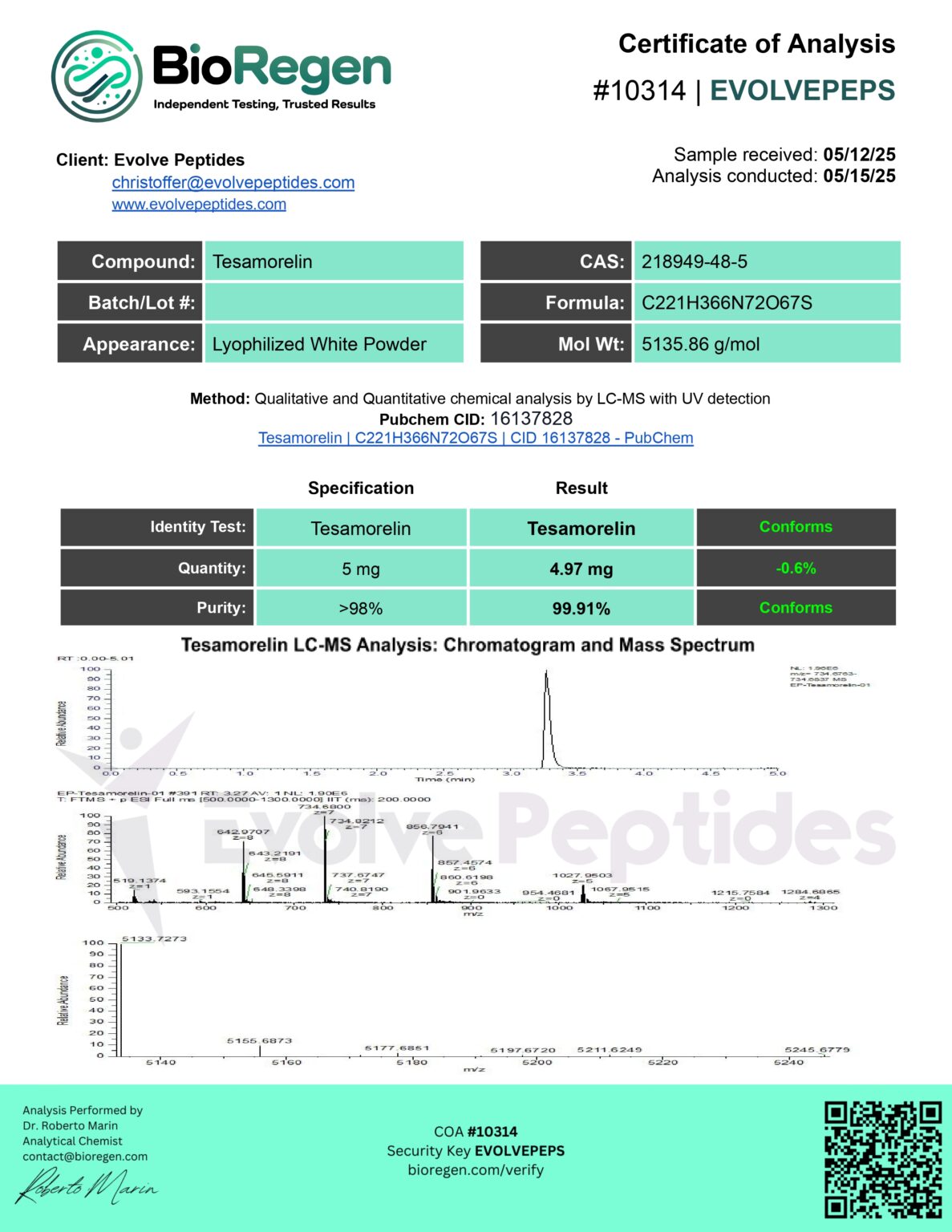
| A purity certificate naming BioRegen as laboratory and the method as LC-MS with UV detection, but with an empty Batch/Lot field [3] | 2. Lot linkage | Which lot was tested, and is it the lot you will ship? |
| An endotoxin report on the same product page naming lot 4185927036, from a different laboratory eight months later [4] | 2. Cannot be tied to the purity report | Are purity and endotoxin results available for the same lot? |
| Three certificates captioned "Independent HPLC testing by Janoshik Analytical - Manufacturer's Report," all titled 10 mg on a page whose default selection is the 2 mg vial [6] | 1 and 2. Whose sample, which lot | Was the sample drawn from your stock, and from which lot? |
| "Every order ships with a third-party Certificate of Analysis," with no laboratory named on public pages and terms that do not warrant certificate accuracy [7] [8] | 1. Laboratory not named | Send a sample certificate naming the laboratory before I order |
| A laboratory verification portal that retrieves the original record, with no accreditation claim on the page [5] | 5. Competence not shown | Which accreditation body, and which methods are in scope? |

What even a good third-party report cannot tell you
A report describes the sample tested, at the time it was tested. One supplier's own disclaimer states that testing results represent findings at the time of analysis only. [9] The endotoxin report above records two vials tested. [4] Neither tells you about the vial in your hands after shipping and storage.
Purity and content are also different measurements. Bachem describes HPLC purity as the main peak's share of total peak area and net peptide content as peptide relative to counter-ions and moisture. [2] A third-party purity figure does not tell you how much peptide a vial contains.
A fictional review, written up
Supplier Z's listing says "third-party tested, 99% purity." You request the lot certificate. It names Laboratory Q, gives HPLC-UV purity and an MS identity result with dates, and states lot ZX-104. Your vial label reads ZX-104. Laboratory Q's website names an accreditation body; on that body's directory, the laboratory is listed but HPLC purity of peptides is not in its scope.
Record it as: independent laboratory, yes; lot linkage, yes; method and date, yes; accreditation, present but not for this test. The claim is partly verified. Whether that is enough is your reviewer's decision, and the record makes the gap visible.
Questions before you decide
Does third-party tested mean the peptide is pure?
No. It means someone other than the seller analysed a sample. Whether that tells you anything about your vial depends on lot linkage, method, date and the laboratory's competence.
Is a Janoshik or other named lab certificate enough?
A named laboratory answers only the first question. You still need the lot to match your vial, a stated method and date, and a way to confirm the laboratory's competence for that test.
How do I check a laboratory's accreditation?
Find the accreditation body named by the laboratory, confirm the body is an ILAC MRA signatory, then look the laboratory up in that body's directory and check that the method is in its scope.
Check the underlying evidence
Sources & review dates
- ILAC: ILAC MRA and signatories ↗Accessed 29 Oct 2026
- Bachem: Quality control of amino acids and peptides, a guide ↗Accessed 29 Oct 2026
- Evolve Peptides: tesamorelin 5 mg purity certificate image (BioRegen, COA 10314) ↗Accessed 29 Oct 2026
- Evolve Peptides: tesamorelin 5 mg endotoxin report image (MZ Biolabs, lot 4185927036) ↗Accessed 29 Oct 2026
- BioRegen: certificate verification portal ↗Accessed 29 Oct 2026
- Peptides EU: Tesamorelin product page (certificate captions) ↗Accessed 29 Oct 2026
- OMNI Peptides: Refund and Returns Policy ↗Accessed 29 Oct 2026
- OMNI Peptides: Terms and Conditions ↗Accessed 29 Oct 2026
- OMNI Peptides: Disclaimer ↗Accessed 29 Oct 2026
Sources are documentary evidence. They do not establish firsthand testing of a listed supplier.