The practical answer
On public documents alone, Evolve Peptides showed the most: named laboratories, stated methods, test dates and a lot number on its endotoxin report. But the purity report we read left the lot field blank, and neither laboratory's website claims accreditation. Peptides EU names Janoshik Analytical but labels its certificates as manufacturer's reports, without a lot number or date in the page text. OMNI Peptides shows no certificates on its public pages, and its catalog is behind an eligibility gate. None met every criterion. [1] [4] [5] [8] [11]
Evidence, method & source dates ↓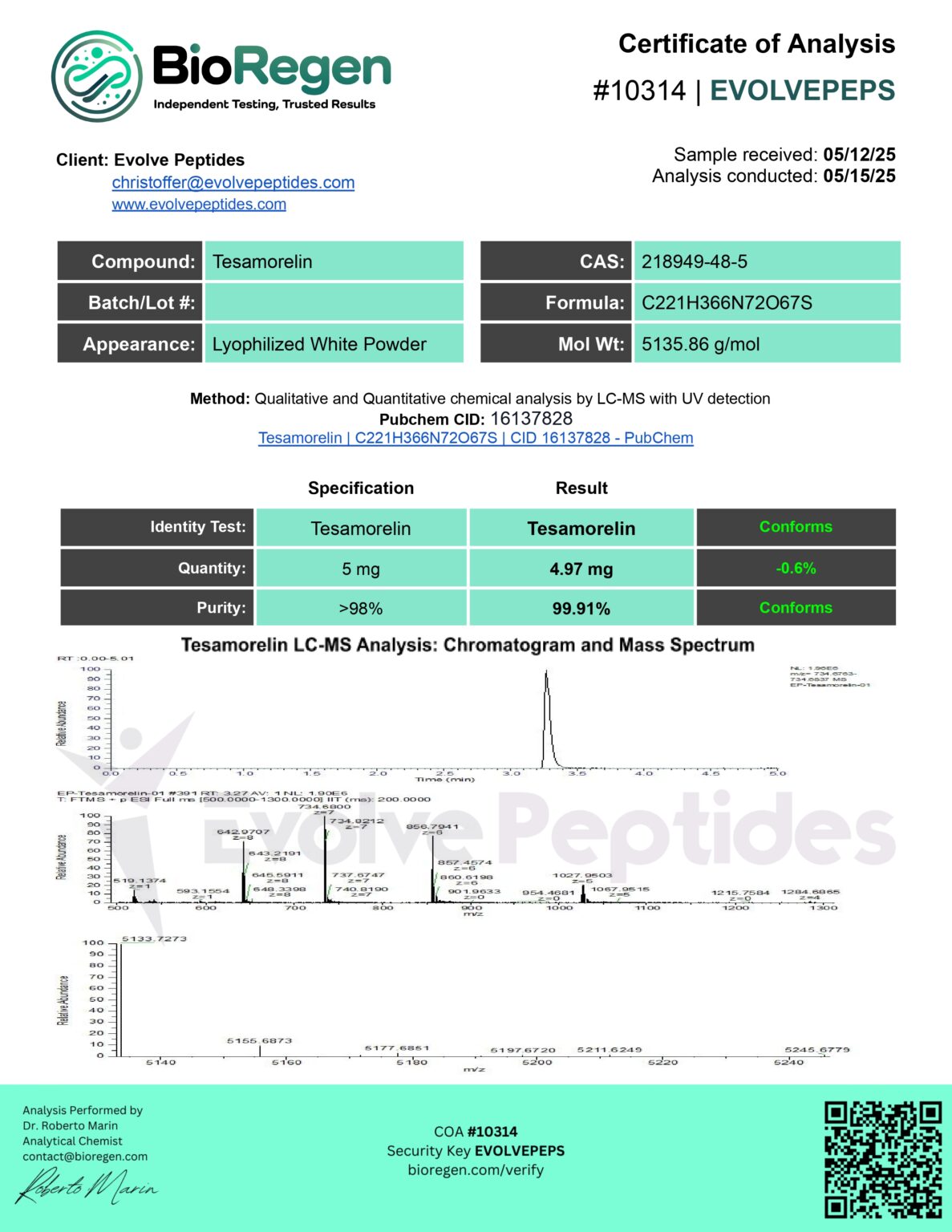

Start with this documentation source
Research supplier
OMNI Peptides
Request a lot-matched original certificate of analysis with method, laboratory and test date, plus a complete delivery quotation for your destination. Leave the review unresolved if those records cannot be supplied.
Not publicly listed; check the gated catalog
Site sits behind a research-access gate. Vendor statements are not independent test results. No purchase or supplier-quality assessment performed.
Affiliate link: we may earn a commission on an eligible purchase. Link disclosure
Start with this documentation source
Research supplier
Peptides EU
Compare posted HPLC and mass-spectrometry documentation claims against a lot-matched original report and a complete delivery quotation; exclude if only a marketing purity badge is available or if quantity basis is undefined.
Product prices not evaluated
Vendor statements are not independent test results. No purchase or supplier-quality assessment performed.
Affiliate link: we may earn a commission on an eligible purchase. Link disclosure
How we ranked, and what the ranking is not
We ranked three suppliers covered on this site by five things a buyer can check without buying: whether a certificate is tied to a lot, whether the testing laboratory is named on it, whether the method is stated, whether a test date is shown, and whether the laboratory's accreditation can be confirmed with an accreditation body. We read each supplier's public pages and any certificate images we could open on 29 October 2026.
This ranks documentation, not product quality. We have not bought from any of these suppliers or had material tested, and a well-documented certificate can still describe a different lot from the one you receive. Where we could not check something, the table says not verified rather than guessing.
The criteria table
| Criterion | Evolve Peptides | Peptides EU | OMNI Peptides |
|---|---|---|---|
| Lot-specific certificate visible before purchase | Partly: endotoxin report shows lot 4185927036; purity report's lot field is blank [4] [5] | Not shown in page text; certificate images not reviewed here, open them on the supplier page [8] | No: no certificates on public pages; catalog behind eligibility gate [13] |
| Testing laboratory named | Yes, on each report: BioRegen (purity), MZ Biolabs (endotoxin) [4] [5] | Yes: Janoshik Analytical, captioned "Manufacturer's Report" [8] | Not on pages we read [11] [12] [13] |
| Method stated | Yes: LC-MS with UV detection; kinetic turbidimetric endotoxin assay [4] [5] | HPLC and mass spectrometry stated generally [8] [9] | Not on pages we read |
| Test date shown | Yes: analysis 15 May 2025 (purity); test 22 Jan 2026 (endotoxin) [4] [5] | Not in page text [8] | Not on pages we read |
| Lookup or verification route | Batch-number lookup on supplier site; BioRegen portal by COA number and key [2] [6] | None described; FAQ suggests sending samples to your own accredited lab [10] | None public |
| Accreditation verifiable | Not verified: neither lab's page we read claims ISO/IEC 17025 [6] [7] | Not verified: Janoshik's site blocked our request | Not verified: lab not named |
1. Evolve Peptides: the most visible documentation, with a lot gap
Evolve's homepage says batches are third-party tested for purity, quantity, sterility, endotoxins and heavy metals, names Chromate, Janoshik and MZ Biolabs, and offers a batch-number lookup that returns a certificate and an endotoxin report. [1] [2] Its tesamorelin 5 mg page displays two documents we could read. [3]
The purity certificate is issued by BioRegen to Evolve Peptides as client, states the method as qualitative and quantitative LC-MS with UV detection, reports 99.91 percent purity against a greater-than-98-percent specification and 4.97 mg against 5 mg, and shows sample receipt on 12 May 2025 and analysis on 15 May 2025. Its Batch/Lot field is empty. [4] The endotoxin report from MZ Biolabs names lot 4185927036, two vials tested, a kinetic turbidimetric assay, a test date of 22 January 2026 and a negative result. [5]
Those are good fields to see. The problem is linkage: a purity report with no lot, issued eight months before an endotoxin report on a named lot, cannot be shown to describe the same material, or the vial you would receive. BioRegen also does not appear in the homepage's list of named laboratories. [1] [4] BioRegen's verification page lets you retrieve the original record with the certificate number and key, which is a real strength; neither BioRegen's nor MZ Biolabs' pages we read claim ISO/IEC 17025 accreditation. MZ Biolabs' homepage does not list endotoxin testing among its services and cites a DEA registration, which is a controlled-substances licence, not a quality accreditation. [6] [7]
Evolve's homepage also advertises a 200 percent money-back guarantee if purity does not match the label, but its guarantee page describes a 60-day results-or-refund policy without defining how a purity dispute is decided. [1] [14]
2. Peptides EU: a named laboratory, but weak lot linkage
Peptides EU names one laboratory, Janoshik Analytical, says testing uses HPLC and mass spectrometry, and says selected independent certificates are published on product pages. [8] [9] [10] The word "selected" matters: it tells you not every batch has a published certificate.
On the tesamorelin page, three documents are listed as purity, endotoxin and sterility. Each is titled "Tesamorelin 10mg" and carries the same caption, "Independent HPLC testing by Janoshik Analytical - Manufacturer's Report." [8] The page's default selection is the 2 mg vial, yet all three documents are titled 10 mg. A manufacturer's report usually means the sample was submitted by the producer rather than by the retailer from stock; ask whose sample was tested and from which lot. The page text shows no lot number or test date, and the certificate images are not reviewed here, so open them on the supplier page to see whether those details appear on the images themselves.
Peptides EU's FAQ suggests that researchers who need more assurance send samples to an accredited laboratory of their choice. [10] That is honest, and it tells you the supplier's own documents are not intended as the final word. We could not reach Janoshik's website to check any accreditation claim.
3. OMNI Peptides: statements without public documents
OMNI's returns policy says every order ships with a third-party certificate of analysis, and its site footer describes products as backed by third-party testing and full documentation on every batch. [11] [16] No certificate is published on the public pages we read; the catalog sits behind a researcher eligibility gate that we did not pass, no testing laboratory is named on the pages we read, and the terms say certificates are informational and their accuracy is not warranted. [12] [13]
That leaves nothing to check before purchase. OMNI may well hold good documents; the point is that a buyer cannot see them from public pages. Ask for a sample certificate for the exact lot, with the laboratory named, before ordering.
A reference point: lot-specific data from an established reagent house
For contrast, Bachem offers an Analytical Data Sheet download for any product by entering the product number and origin batch number printed on labels, invoices and packing lists. [15] That is lot linkage built into the ordering paperwork. Bachem's page does not say who performs the analysis, so it is a lot-specific document, not necessarily a third-party one. The two properties are different, and the strongest packet has both.
Who should choose which
- Choose on documentation, not on the word "tested": ask every supplier for a certificate naming the lot you will receive, the laboratory, the method and the test date.
- Evolve fits a buyer who wants to see real reports before ordering and will use its batch lookup and BioRegen's verification portal after delivery. Ask why the purity report has no lot. [2] [4] [6]
- Peptides EU fits an EU buyer who will request the lot's certificate in writing, or arrange independent testing as its FAQ suggests. [10]
- OMNI fits only a buyer prepared to request documents before paying and to walk away if none arrive. [11] [12]
- If your work requires accredited results, none of these is enough on its own. Check the laboratory's accreditation body and scope yourself.
Questions before you decide
Which peptide supplier has the best third-party testing?
Among the three we checked, Evolve Peptides shows the most documentation publicly, including named laboratories, methods and dates. None met every criterion: Evolve's purity report lacked a lot number, Peptides EU's certificates are manufacturer's reports without visible lot details, and OMNI shows no certificates publicly.
Does a named lab mean the results are accredited?
No. Accreditation has to be confirmed with the accreditation body, for the specific test. Neither laboratory page we read for Evolve's reports claimed ISO/IEC 17025 accreditation.
Check the underlying evidence
Sources & review dates
- Evolve Peptides: homepage (testing claims and named laboratories) ↗Accessed 29 Oct 2026
- Evolve Peptides: COA lookup ↗Accessed 29 Oct 2026
- Evolve Peptides: Tesa 5 mg product page ↗Accessed 29 Oct 2026
- Evolve Peptides: tesamorelin 5 mg purity certificate image (BioRegen, COA 10314) ↗Accessed 29 Oct 2026
- Evolve Peptides: tesamorelin 5 mg endotoxin report image (MZ Biolabs, lot 4185927036) ↗Accessed 29 Oct 2026
- BioRegen: certificate verification portal ↗Accessed 29 Oct 2026
- MZ Biolabs: homepage ↗Accessed 29 Oct 2026
- Peptides EU: Tesamorelin product page (certificate captions) ↗Accessed 29 Oct 2026
- Peptides EU: About ↗Accessed 29 Oct 2026
- Peptides EU: Frequently Asked Questions ↗Accessed 29 Oct 2026
- OMNI Peptides: Refund and Returns Policy ↗Accessed 29 Oct 2026
- OMNI Peptides: Terms and Conditions ↗Accessed 29 Oct 2026
- OMNI Peptides: homepage and access gate ↗Accessed 29 Oct 2026
- Evolve Peptides: Our Guarantee ↗Accessed 29 Oct 2026
- Bachem: Analytical Data Sheet (ADS) ↗Accessed 29 Oct 2026
- OMNI Peptides: Disclaimer (site footer testing statement) ↗Accessed 29 Oct 2026
Sources are documentary evidence. They do not establish firsthand testing of a listed supplier.